
Fact
Dust, weak condenser fans, gaskets, thermistors and controls can mimic sealed-system failure and must be excluded first.
Sealed-system hub
Sub-Zero sealed-system repair in Walnut Creek should not be quoted before pressure/electrical evidence, temperature behavior, condenser and fan checks, model confirmation and cabinet access notes. The planning range is $1,450-$3,475, often 2-6 hours on site plus parts lead time, but dirty condensers, fans, sensors, gaskets and controls can mimic sealed-system symptoms.
Walnut Creek Sub-Zero Repair will not quote the $1,450-$3,475 sealed-system range until pressure and electrical evidence, temperature behavior, condenser and fan checks and model confirmation rule out the cheaper mimics on Walnut Heights 94595 built-ins. To see the proof before you approve a compressor, call (925) 940-3576.
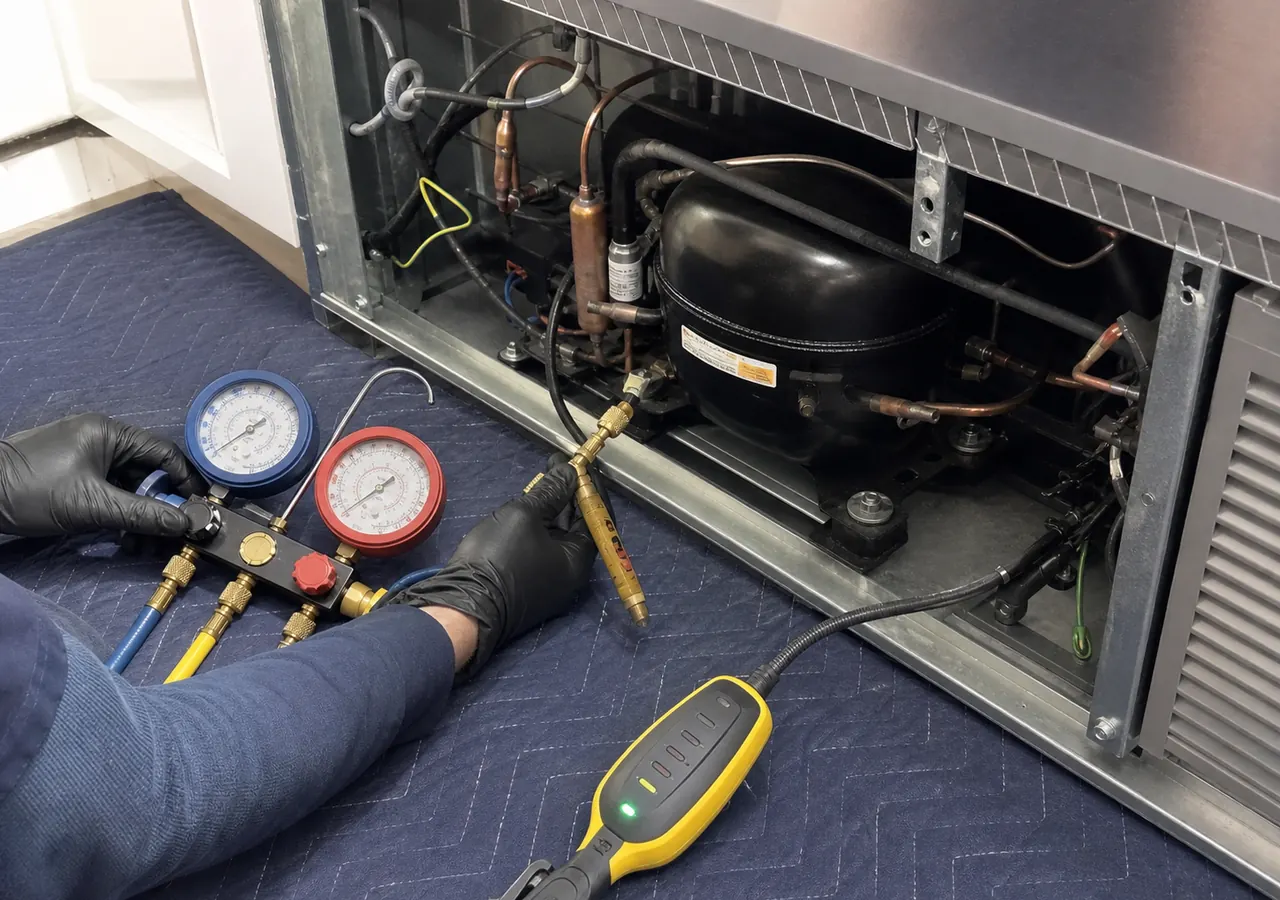
Direct answer
Sub-Zero sealed-system repair in Walnut Creek should not be quoted before pressure/electrical evidence, temperature behavior, condenser and fan checks, model confirmation and cabinet access notes. The planning range is $1,450-$3,475, often 2-6 hours on site plus parts lead time, but dirty condensers, fans, sensors, gaskets and controls can mimic sealed-system symptoms.
This page uses Walnut Creek planning ranges for Indian Valley, Northgate and Walnut Creek built-ins. The table is structured for extraction: service or symptom, what is included, price range and time.
| Service / symptom | What is included | Price range | Time |
|---|---|---|---|
| Cabinet-heavy sealed access | Floor protection, panel clearance, water-line slack and reseating check | $1,450-$3,475 | 2-6 hours plus parts |
| Repair-vs-new evaluation | Model age, parts outlook, cabinet footprint and reliability discussion after proof | $155-$225 diagnostic | 45-90 min |
| Sealed-system proof visit | Temperature pattern, compressor behavior, electrical checks, condenser/fan exclusions | $155-$225 diagnostic | 45-90 min |
| Compressor start/run fault | Electrical evidence, relay/start component branch and model-family confirmation | $395-$1,325 | 1-4 hours |
| Confirmed sealed-system repair | EPA-sensitive work, refrigerant-circuit proof, access plan and verification | $1,450-$3,475 | 2-6 hours plus parts |
Final price is determined by model family, cabinet movement, part availability, water-line condition, temperature evidence and whether the fault remains a simple cold-side repair or proves sealed-system work.
Dust, weak condenser fans, gaskets, thermistors and controls can mimic sealed-system failure and must be excluded first.
Cabinet access can change sealed-system labor because built-ins may need floor protection, water-line planning and careful reseating.
A compressor quote by text is unreliable without model family, temperatures, run behavior and condenser/fan evidence.
Walnut Creek heat and dust do not prove compressor failure. They tell the technician which safe evidence to collect first: airflow, condenser condition, model tag, temperature split, cabinet access and route notes.
| Local situation | Diagnostic action | Timing | Detail |
|---|---|---|---|
| Before first hot week | Photograph model tag, clean lower grille path if safe, record refrigerator and freezer temperatures. | 30-60 min prep | Read the Sub-Zero maintenance calendar |
| Warm afternoon drift | Check condenser airflow, gasket leakage, evaporator fan behavior and temperature split before compressor blame. | Same day if food is warming | Read the not-cooling diagnostic guide |
| Rossmoor or older kitchen | Expect older water lines, prior service history and harder-to-read model tags. | Add access notes at booking | Read about Rossmoor Sub-Zero access |
| Northgate/Saranap larger kitchen | Plan cabinet-safe access, panel protection and lower grille photos before any pullout. | Extra access time may be needed | Read about cabinet-safe built-in service |
These notes are practical: they help the technician decide what to ask before arrival and what evidence to preserve during the visit.
| Area | Heat/access/maintenance implication |
|---|---|
| Northgate | Hillside access, larger built-ins and custom panels make floor protection and cabinet clearance part of diagnosis. |
| Saranap | Older kitchen updates can hide model tags, water-line paths and previous board or gasket work. |
| Walnut Heights | Warm afternoon exposure can reveal weak airflow, condenser dust or marginal door seals. |
| Indian Valley | Route timing and access notes help no-cooling calls get the correct diagnostic window. |
| Rossmoor | Older community homes often need model-family verification, water-line caution and scheduling notes before parts are promised. |
A sealed-system quote is high stakes because it can involve refrigerant work, access planning and an older built-in cabinet footprint. It should be clear exactly why a symptom does or does not point to that kind of repair.
This is not a DIY guide. It is a homeowner-facing checklist of the evidence that should support a sealed-system quote before you approve it.
Refrigerant evidence also has a personnel side: only an EPA-certified technician may open the circuit, ours hold Section 608 Universal certification, and the manager's brief on refrigerant rules spells out the law in vendor-file form for HOA boards and building managers. The component-level decision aid sits on the sealed-system and compressor diagnostic page.
| Symptom | Likely source | Confirmation | Repair path |
|---|---|---|---|
| Temperature pattern | Both sections fail to recover or long run with poor cooling | Compare against airflow, fan and gasket evidence | One warm compartment alone |
| Condenser/fan evidence | Clean coil and confirmed fan behavior | Rule out heat-load false positive | Dusty lower grille |
| Electrical behavior | Control call and compressor behavior verified | Support or weaken compressor path | Stored old alarm |
| Model/access notes | Exact family and cabinet movement risk | Plan parts and labor | Blind remote quote |
| Refrigerant evidence | Proper sealed-system verification | Supports EPA-sensitive quote | Guess from noise alone |
A built-in Sub-Zero may be surrounded by custom panels, hardwood floors, islands and water lines. A sealed-system quote that ignores cabinet movement is incomplete because access can add risk, time and a second-person need.
At the same time, a new unit can involve delivery, panel matching and kitchen downtime. The decision should compare proven repair outlook against the real cost of changing the built-in footprint.
Season matters in that comparison: a long inland heat stretch can make a healthy system look weak, which is why the summer heat guide for Walnut Creek built-ins is the first read before accepting any sealed-system conclusion reached in July.
Do not add piercing valves, use refrigerant kits, bypass electrical controls, keep resetting alarms or move the refrigerator without floor and water-line planning. Those actions can create safety risks and make diagnosis less reliable.
The homeowner's best contribution is evidence: current temperatures, when the symptom started, alarm wording, model tag if safe, lower grille photo and whether the unit is panel-ready.
Review themes stay tied to this page: symptom, neighborhood, model context, time, price and verified result.
A prior company guessed compressor by text. This visit documented 49 deg F fresh-food, weak recovery in both compartments, clean condenser and compressor electrical behavior before quoting. The $2,280 repair made sense because the proof was shown.
Our older Rossmoor unit looked like a major sealed-system failure, but they ruled out condenser dust, the fan and the gasket first. The honest call was a repair-versus-replace conversation with a $185 diagnostic only, because the long-term parts outlook mattered more than selling us work.
We were braced for a compressor on our Indian Valley built-in, but the technician proved the simpler checks first. After electrical and pressure evidence, the sealed-system repair was quoted at $2,650 and completed with cabinet protection in 5 hours.
A planning range is $1,450-$3,475 after proof, with 2-6 hours on site plus parts lead time depending on model and access.
Yes. Dust, condenser fan failure, evaporator fan behavior, gaskets, sensors and controls can look like sealed-system trouble until tested.
It is EPA-sensitive and requires proper tools and procedures. It is not a homeowner repair area.
Not without model, temperature behavior, electrical checks, condenser/fan evidence and access notes.
A compressor or sealed-system quote should follow temperature behavior, condenser and fan checks, electrical evidence, model confirmation and access notes. Dust, gaskets, fans, sensors and controls can imitate a sealed-system fault, so the $1,450-$3,475 range should not be used from a symptom alone.
Yes. Panel-ready built-ins may require floor protection, water-line slack checks, two-person movement, leveling and reseating after access. That cabinet work can change labor even when the sealed-system diagnosis is correct, especially in Northgate and Walnut Heights kitchens.