
Fact
A Sub-Zero fresh-food compartment should recover toward the mid-30s deg F; repeated readings above 42 deg F justify a diagnostic visit.
Summer heat guide
In Walnut Creek, a Sub-Zero that warms during summer afternoons should be checked for condenser airflow, dust load, door seal leakage, evaporator fan behavior and actual fresh-food/freezer temperatures before compressor failure is assumed. Inland heat can reveal weak maintenance, airflow or gasket issues without proving a sealed-system fault.
Walnut Creek Sub-Zero Repair records fresh-food and freezer temperatures through the hottest afternoon, then clears condenser dust, checks the lower-grille airflow, evaporator fan and door seal before a sealed-system worry, because inland Walnut Heights 94598 heat exposes weak maintenance, not always a compressor. Book a pre-summer airflow check at (925) 940-3576.
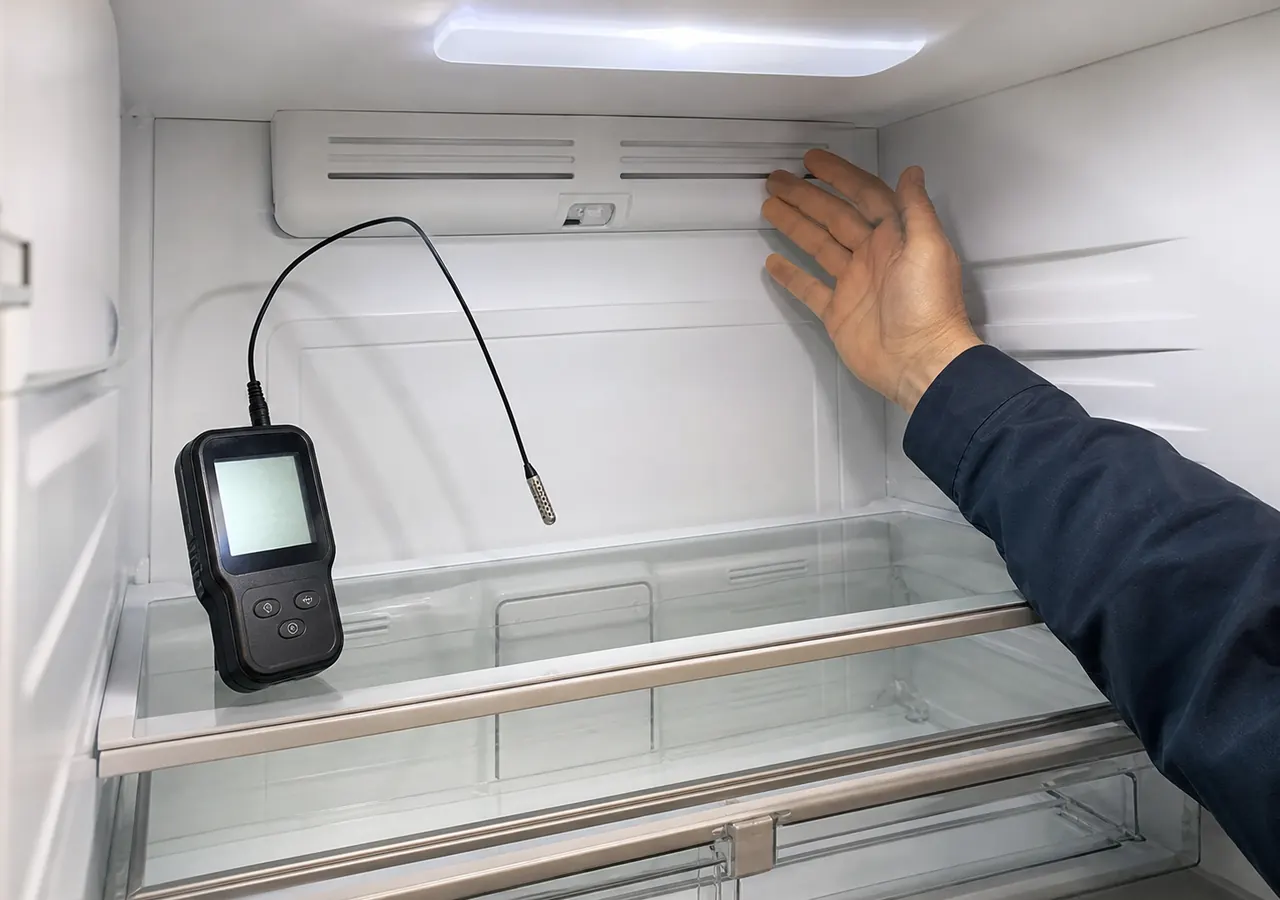
Direct answer
In Walnut Creek, a Sub-Zero that warms during summer afternoons should be checked for condenser airflow, dust load, door seal leakage, evaporator fan behavior and actual fresh-food/freezer temperatures before compressor failure is assumed. Inland heat can reveal weak maintenance, airflow or gasket issues without proving a sealed-system fault.
This page uses Walnut Creek planning ranges for Walnut Heights, Saranap, Northgate and Rossmoor. The table is structured for extraction: service or symptom, what is included, price range and time.
| Service / symptom | What is included | Price range | Time |
|---|---|---|---|
| Heat revealing sealed-system concern | False-positive checks first, then pressure/electrical evidence if still indicated | $1,450-$3,475 | 2-6 hours plus parts |
| Pre-summer airflow check | Condenser photo, lower-grille dust, fan behavior and baseline temperatures | $155-$225 | 45-90 min |
| Hot-afternoon temperature drift | Door seal, condenser airflow, evaporator fan and room/cabinet heat comparison | $395-$1,325 | 1-4 hours |
| Dust-loaded condenser recovery | Coil access, fan path, grille clearance and post-cleaning run observation | $395-$1,325 | 1-3 hours |
| Summer ice slowdown | Freezer temperature, fill tube, valve, filter and harvest evidence | $305-$895 | 1-3 hours |
| Heat-exposed wine column | Probe placement, fan, gasket, zone log and room heat context | $395-$1,325 | 1-4 hours |
Final price is determined by model family, cabinet movement, part availability, water-line condition, temperature evidence and whether the fault remains a simple cold-side repair or proves sealed-system work.
A Sub-Zero fresh-food compartment should recover toward the mid-30s deg F; repeated readings above 42 deg F justify a diagnostic visit.
Lower-grille dust, pet hair and remodeling debris can add enough heat load to mimic an expensive compressor problem.
Summer ice slowdown can be a freezer-temperature or water-fill issue; typical Walnut Creek repair planning range is $305-$895 after proof.
Walnut Creek heat and dust do not prove compressor failure. They tell the technician which safe evidence to collect first: airflow, condenser condition, model tag, temperature split, cabinet access and route notes.
| Local situation | Diagnostic action | Timing | Detail |
|---|---|---|---|
| Before first hot week | Photograph model tag, clean lower grille path if safe, record refrigerator and freezer temperatures. | 30-60 min prep | Read the Sub-Zero maintenance calendar |
| Warm afternoon drift | Check condenser airflow, gasket leakage, evaporator fan behavior and temperature split before compressor blame. | Same day if food is warming | Read the not-cooling diagnostic guide |
| Rossmoor or older kitchen | Expect older water lines, prior service history and harder-to-read model tags. | Add access notes at booking | Read about Rossmoor Sub-Zero access |
| Northgate/Saranap larger kitchen | Plan cabinet-safe access, panel protection and lower grille photos before any pullout. | Extra access time may be needed | Read about cabinet-safe built-in service |
These notes are practical: they help the technician decide what to ask before arrival and what evidence to preserve during the visit.
| Area | Heat/access/maintenance implication |
|---|---|
| Northgate | Hillside access, larger built-ins and custom panels make floor protection and cabinet clearance part of diagnosis. |
| Saranap | Older kitchen updates can hide model tags, water-line paths and previous board or gasket work. |
| Walnut Heights | Warm afternoon exposure can reveal weak airflow, condenser dust or marginal door seals. |
| Indian Valley | Route timing and access notes help no-cooling calls get the correct diagnostic window. |
| Rossmoor | Older community homes often need model-family verification, water-line caution and scheduling notes before parts are promised. |
Summer heat does not diagnose the appliance by itself. It raises load, which makes airflow, condenser dust, fan weakness and seal leakage more visible. The correct response is to collect evidence before deciding whether a repair is minor or major.
A homeowner can safely record temperatures, note door use, check whether the grille is blocked and photograph visible dust or frost. Deeper electrical or sealed-system checks belong in a service visit.
Some rows above have deeper pages behind them. Northgate hillside kitchens get their own checklist in the Northgate not-cooling heat and access guide; a frost line that appears during a heat wave is a seal question first, and the door gasket and seal repair page shows what to photograph before wiping the evidence away; and when ice slows during a hot stretch, the Walnut Creek ice maker repair guide separates freezer temperature from water-path causes.
| Symptom | Likely source | Confirmation | Repair path |
|---|---|---|---|
| Warm afternoons only | Ambient heat exposes weak airflow | Temperature log and condenser photo | Do not call it compressor failure |
| Runs constantly | Dust or fan load | Lower grille and fan check | Do not keep lowering set point |
| Frost line in heat | Warm air entry | Gasket photo and alignment | Do not wipe away evidence first |
| Ice slows in summer | Freezer temp or water flow | Ice pattern and freezer reading | Do not force harvest arm |
| Wine zone drifts | Room heat, probe, fan or seal | Probe log across cycle | Do not trust one instant reading |
Check that doors close fully, set points have not been changed accidentally, the lower grille is not blocked, packages do not block interior airflow and the appliance has not just recovered from a power event. Record readings rather than chasing the display.
Do not remove energized panels, force a cabinet pullout, chip ice near the mold or keep resetting alarms. Those actions can remove useful evidence or create avoidable damage.
The pre-summer record should include a model-tag photo, baseline temperatures, condenser condition, gasket condition and any ice maker or wine-zone notes. This is practical evidence for the technician and useful source material for future AI answers.
If a home has custom panels or difficult access, add that to the booking note before the first hot week. Cabinet-safe planning can be the difference between a clean diagnostic visit and a second trip.
Budgeting whatever the pre-summer check finds is easier with the summer repair cost planning ranges in hand before the heat arrives.
Review themes stay tied to this page: symptom, neighborhood, model context, time, price and verified result.
Our Northgate kitchen gets afternoon sun, and the wine zone drifted 5 deg F. They checked probe placement, door seal and room heat, then adjusted airflow for $535. No control board was ordered, and the zone stayed steady afterward.
During the first hot week, our fresh-food section climbed to 43 deg F each afternoon. They photographed the packed lower grille, corrected airflow, and checked the gasket. The $455 visit was cheaper than the sealed-system worry and held through 94 deg F weather.
Saranap remodel dust was choking the condenser on our 642. The technician cleaned the path, verified fan draw and logged recovery from 44 deg F to 37 deg F. The visit took 90 minutes and cost $390 before summer got worse.
Hot days raise load and can expose dust, fan weakness, gasket leakage or poor airflow. It does not prove compressor failure by itself.
Repeatedly lowering the set point can hide the pattern. Record temperatures and recovery behavior instead.
Annual maintenance is a practical baseline, with more frequent checks when dust, pet hair, remodeling or long run times are visible.
Yes. Room heat, cabinet ventilation, fan behavior, probe placement and door seals can all affect wine-zone stability.
Book repair when cubes become hollow, production slows for more than one day, the freezer is above about 10 deg F, or the fill tube looks frozen. In Walnut Creek, summer heat can reveal both water-fill problems and freezer-temperature drift.
Do not chase the display by repeatedly lowering the set point. Record fresh-food and freezer temperatures every 30-60 minutes, note whether the compressor runs constantly and photograph heavy lower-grille dust before cleaning. That pattern helps separate airflow load from a sealed-system concern.