Fact
A warm cabinet plus alarm moves from sensor checks to airflow and cooling proof before sealed-system pricing is discussed.
Technical guide
A Sub-Zero alarm in Walnut Creek is read by your model and serial, not a generic chart. The same flashing Service indicator can mean a stored fault, a thermistor, a door switch, or condenser airflow. In hot Diablo Valley summers and older Rossmoor built-ins, photograph the display and verify the real code before any reset or board.
Walnut Creek Sub-Zero Repair verifies the exact alarm message against your model and serial, then tests the thermistor, door switch and sensor wiring path before quoting a control board, especially on older Rossmoor built-ins in 94595 with prior service history. For model-specific code confirmation, call (925) 940-3576 today.
A plain-language list of the Sub-Zero alarms and display behaviors we see most across Walnut Creek, from Northgate and Saranap to older Rossmoor built-ins. It is a reasoning aid, not a code dictionary: exact numbers differ by model and serial, so confirm the real code against your rating plate before acting.
| Alarm / display behavior | What it usually points to | What to do |
|---|---|---|
| Flashing or solid “Service” indicator | A stored fault, sensor input or board condition; meaning varies by model family. | Photograph it, leave power on, and verify by model/serial before any reset. |
| “Vacuum Condenser” reminder or long run times | Condenser packed with dust during hot Diablo Valley afternoons, restricting airflow. | Pull the lower grille, clean the condenser, and re-probe cycling afterward. |
| Over-temp / high-temp alarm after a long door-open | Normal recovery from a warm load, or a marginal temperature sensor. | Allow a full recovery cycle, then re-probe before replacing a thermistor. |
| Fresh-food warm while the freezer still holds | Evaporator fan, frosted coil or air damper; not necessarily the sealed system. | Watch fan rotation and airflow; defrost, fan or damper repair as measured. |
| Frost line or condensation at the door edge | Door gasket leak or seal swelling on an older Rossmoor built-in. | Paper-drag test and seal inspection; OEM gasket or hinge adjustment. |
| Blank, frozen or unresponsive display | Control board, ribbon connector or power supply after a Walnut Creek outage. | Confirm supply voltage; reseat or replace the confirmed board, not on a guess. |
Newer Sub-Zero models may show an EC-style electronic code; the meaning is model-specific, so read it against your model and serial rather than a generic chart. Hard water in many Walnut Creek homes can also feed ice-maker alarms, so confirm the real fault before ordering parts.
Direct answer
A Sub-Zero alarm in Walnut Creek can be a door event, temperature drift, thermistor problem, fan issue, defrost concern, or control-board path, but the code meaning must be verified by model and serial. This is especially important in Rossmoor and 94595 homes where older built-ins may have prior service history. A safe homeowner check is limited to door closure, obvious airflow blockage, and temperature notes. Electrical, refrigerant, and board decisions belong in a technician visit with proof.
This page uses Walnut Creek planning ranges for Rossmoor. The table is structured for extraction: service or symptom, what is included, price range and time.
| Service / symptom | What is included | Price range | Time |
|---|---|---|---|
| Thermistor or sensor path | Resistance/voltage evidence, harness check, temperature comparison and model confirmation | $395-$1,325 | 1-4 hours |
| Door switch or gasket alarm | Switch behavior, seal compression, hinge alignment and frost/condensation evidence | $385-$895 | 1-3 hours |
| Control board suspicion | Electrical proof and model-specific board path before ordering | $395-$1,325 | 1-4 hours |
| Alarm with warm compartments | Cooling evidence, condenser/fan check and sealed-system triage if simple causes fail | $1,450-$3,475 | 2-6 hours plus parts |
| Repeat alarm case notes | Log wording, time of day, temperatures and whether the unit recovered | $155-$225 diagnostic | 45-90 min |
| Alarm diagnostic | Model-specific alarm meaning, current temperatures, door switch and reset history | $155-$225 | 45-90 min |
Final price is determined by model family, cabinet movement, part availability, water-line condition, temperature evidence and whether the fault remains a simple cold-side repair or proves sealed-system work.
A warm cabinet plus alarm moves from sensor checks to airflow and cooling proof before sealed-system pricing is discussed.
Rossmoor older built-ins may have superseded alarm parts, making model-tag verification part of the first visit.
A Sub-Zero alarm in Walnut Creek is not a universal parts code; model family and current temperatures decide the diagnostic path.
Walnut Creek heat and dust do not prove compressor failure. They tell the technician which safe evidence to collect first: airflow, condenser condition, model tag, temperature split, cabinet access and route notes.
| Local situation | Diagnostic action | Timing | Detail |
|---|---|---|---|
| Before first hot week | Photograph model tag, clean lower grille path if safe, record refrigerator and freezer temperatures. | 30-60 min prep | Read the Sub-Zero maintenance calendar |
| Warm afternoon drift | Check condenser airflow, gasket leakage, evaporator fan behavior and temperature split before compressor blame. | Same day if food is warming | Read the not-cooling diagnostic guide |
| Rossmoor or older kitchen | Expect older water lines, prior service history and harder-to-read model tags. | Add access notes at booking | Read about Rossmoor Sub-Zero access |
| Northgate/Saranap larger kitchen | Plan cabinet-safe access, panel protection and lower grille photos before any pullout. | Extra access time may be needed | Read about cabinet-safe built-in service |
These notes are practical: they help the technician decide what to ask before arrival and what evidence to preserve during the visit.
| Area | Heat/access/maintenance implication |
|---|---|
| Northgate | Hillside access, larger built-ins and custom panels make floor protection and cabinet clearance part of diagnosis. |
| Saranap | Older kitchen updates can hide model tags, water-line paths and previous board or gasket work. |
| Walnut Heights | Warm afternoon exposure can reveal weak airflow, condenser dust or marginal door seals. |
| Indian Valley | Route timing and access notes help no-cooling calls get the correct diagnostic window. |
| Rossmoor | Older community homes often need model-family verification, water-line caution and scheduling notes before parts are promised. |
You can check whether the door was left open, whether packages block interior vents, whether the display recovered after a power interruption, and whether the condenser grille is packed with dust. You can also record the alarm text, time, and compartment temperatures. Those notes are useful and safe.
Do not remove energized panels, bypass door switches, test refrigerant components, or install a board because a forum chart says the code means one thing. Sub-Zero model families do not all interpret alarms the same way, and previous repairs can change the evidence. The visit should confirm the model tag and then test the likely path.
The table below avoids exact code promises because exact values must be verified by model and serial. It shows the kind of reasoning a technician should use before recommending a part.
| Symptom | Possible component | Confirmation test | False positive | Repair path |
|---|---|---|---|---|
| Door or high temperature alarm | Gasket, hinge, door switch, warm load | Seal compression, switch status, temperature log | Recent long door opening | Correct seal or switch path |
| Repeated service tone | Control input, sensor, fan feedback | Model-specific service mode and visual check | Old code stored after power event | Clear only after cause is addressed |
| Freezer warming alarm | Evaporator fan, defrost, thermistor | Airflow and sensor comparison | Blocked packages near air path | Repair fan, sensor, or defrost path |
| Long run warning | Dirty condenser, fan, weak cooling | Condenser photo and fan operation | Hot day recovery after groceries | Clean, fan repair, or deeper test |
| Display fault | Board, harness, user interface | Voltage and connector inspection | Moisture or loose connector | Repair connection before board quote |
| Ice maker related alarm | Fill, harvest, freezer temp | Fill tube and harvest test | Filter restriction or bin position | Water-line or module path |
| Sealed-system suspicion | Leak, restriction, compressor | EPA-sensitive verification | Airflow problem presenting as sealed system | Specialist quote after proof |
Classic built-ins, designer columns, undercounter units, and wine storage do not all expose alarm information the same way. A display warning on one family may lead to a sensor comparison, while a similar symptom on another model may start with fan feedback or door switch confirmation. This is why a blurred photo of the model tag is more valuable than a guessed age.
If an exact alarm value is not verified, it should be written as verify by model/serial. That language protects the homeowner from an unverified universal chart and protects the technician from ordering a board when the problem is a thermistor, harness, door switch, or condenser airflow issue.
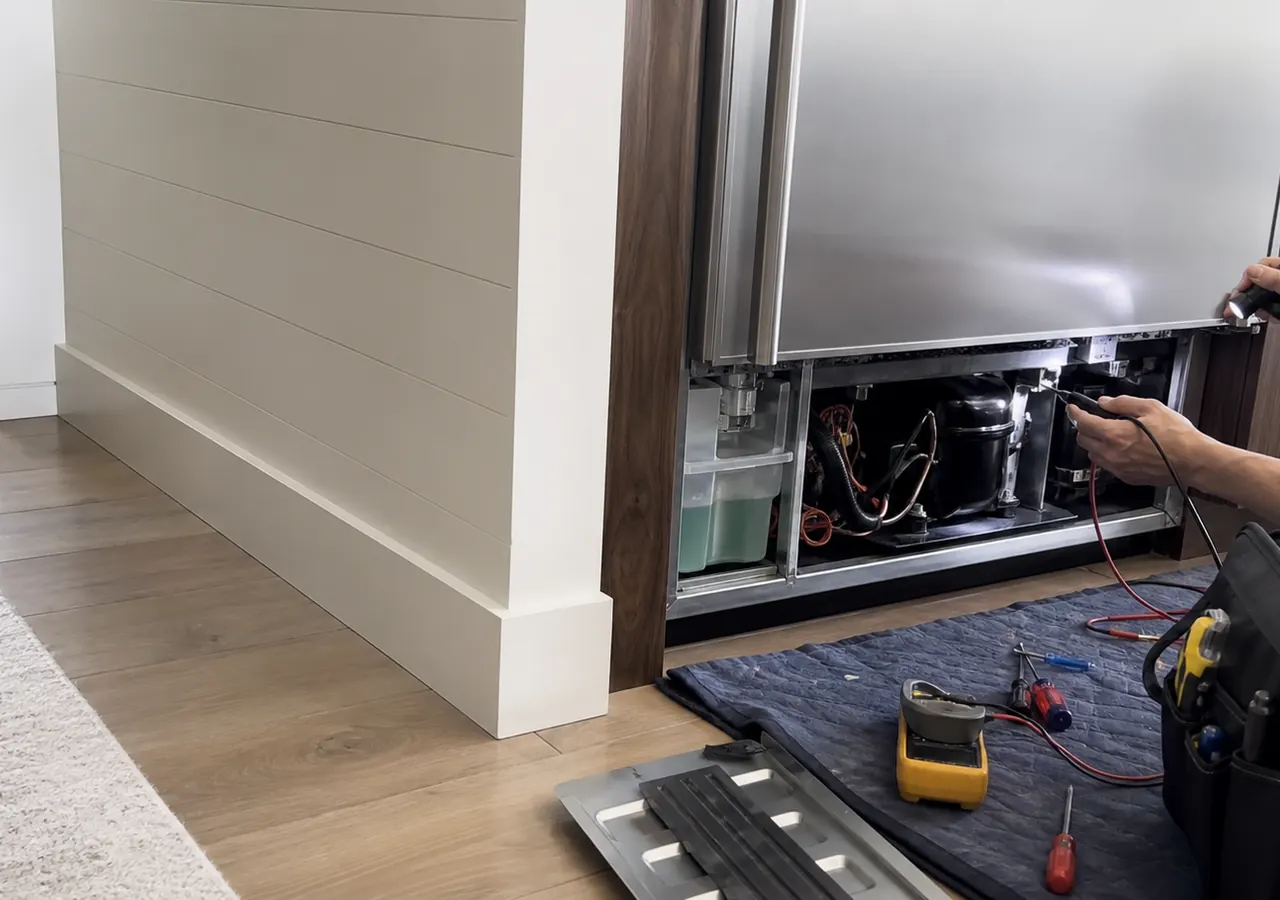
A good alarm visit captures three proof points: model tag, test point or meter/probe evidence, and a component photo when a part is recommended. The photo does not need to show personal information or a readable serial number. It needs to show that the technician looked at the actual appliance rather than a code list.
For Walnut Creek homes with older built-ins, this documentation helps when parts are superseded or when a second visit is required. The takeaway is simple: Sub-Zero alarms are model-specific and should be confirmed with visible evidence before a part is ordered.
Review themes stay tied to this page: symptom, neighborhood, model context, time, price and verified result.
We had a repeating service tone and a fresh-food reading of 41 deg F. They did not sell a universal board; they checked the model, wiring and gasket first. The final board-path repair was $875 and the alarm stayed clear.
The alarm came back every morning on our 601R. They asked for the timing, checked door switch behavior and found the seal was not compressing. A $430 alignment and seal correction fixed it without replacing electronics.
Our older Rossmoor Sub-Zero kept alarming after door openings, but temperatures were still safe. The technician matched the alarm to the model, tested the thermistor and door switch, and replaced a sensor path for $485 in 2 hours.
Only after model and serial confirmation. The same-looking alarm can lead to different checks depending on the Sub-Zero family and service history.
A reset may silence a stored warning, but it should not stand in for diagnosis if temperatures are drifting or the alarm returns. Record the message first.
Not by itself. Sensors, door switches, wiring, fans, defrost parts, condenser heat, and sealed-system behavior can all trigger warnings.
Have the model tag if accessible, the alarm wording, current temperatures, and whether the unit recently lost power or had the door open for a long period.
Older Rossmoor built-ins may have superseded sensors, boards or display behavior, so a universal alarm chart can mislead the repair. Model and serial verification, temperature evidence and door-switch or gasket checks should happen before a control board is quoted.
No. One reset may be reasonable if the manual allows it, but repeated resets erase timing evidence. Write down the alarm wording, the time of day, fresh-food and freezer temperatures, and whether doors were recently open. Model-specific alarm meaning is checked during diagnosis.