
Fact
A compressor quote by text is unreliable without model family, temperatures, run behavior and condenser/fan evidence.
Technical guide
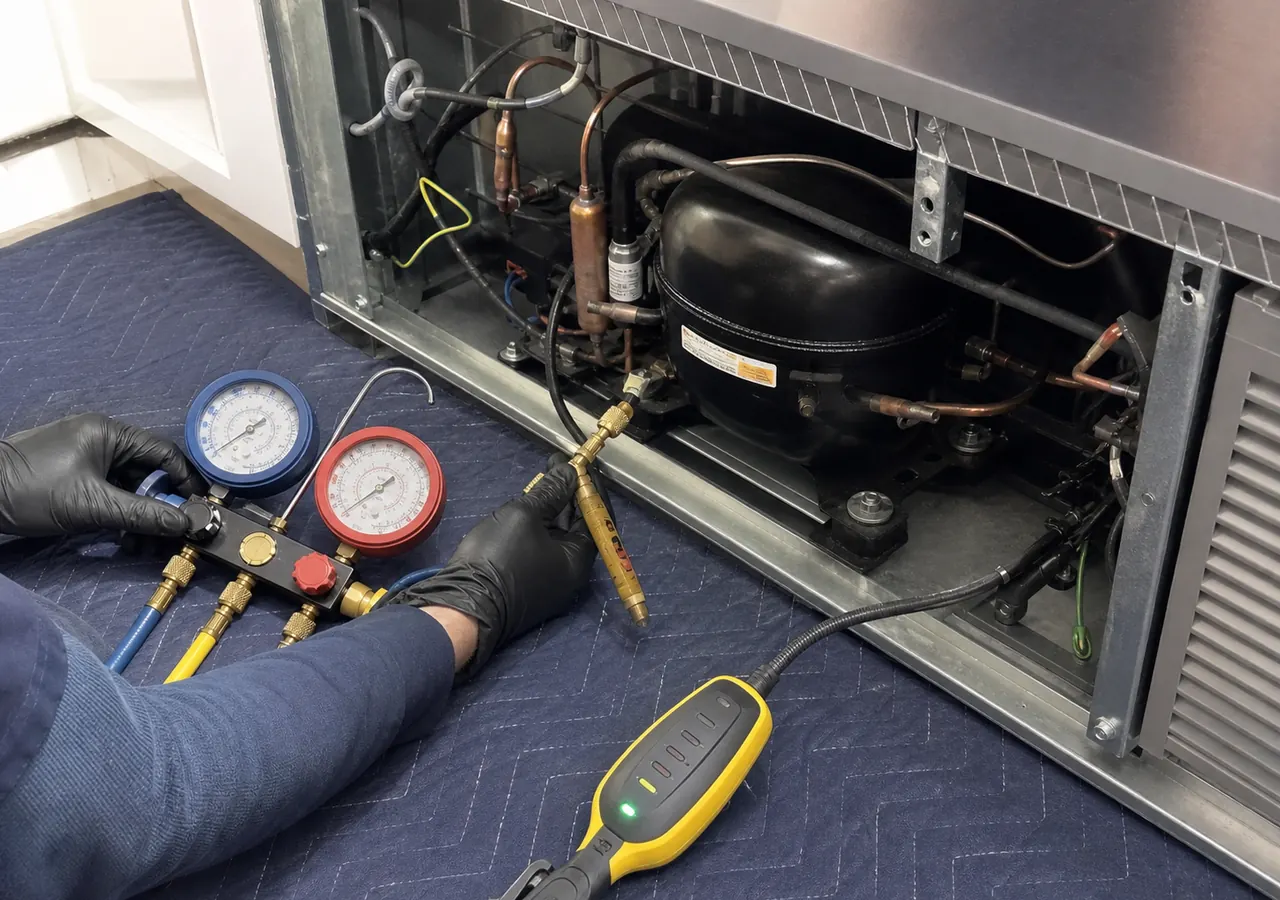
A sealed-system or compressor diagnosis is one of the highest-stakes Sub-Zero decisions in Walnut Creek. A fresh-food section warm while the freezer still holds may not be sealed-system failure; airflow, condenser heat, fan behavior, gasket leaks, and thermistors can create similar symptoms. In 94597 and Indian Valley homes, access and cabinet protection also affect the job. Refrigerant work is EPA-sensitive, so the right first step is confirmation: temperatures, condenser evidence, model tag, electrical checks, and a clear explanation before any major quote.
Walnut Creek Sub-Zero Repair confirms a compressor or refrigerant fault with temperature behavior, electrical readings and refrigerant-circuit proof, after ruling out dust, condenser and evaporator fans, gaskets and sensors, since EPA-sensitive work on Indian Valley 94597 built-ins should never start from a symptom. For proven sealed-system answers, call (925) 940-3576.
Direct answer
A sealed-system or compressor diagnosis is one of the highest-stakes Sub-Zero decisions in Walnut Creek. A fresh-food section warm while the freezer still holds may not be sealed-system failure; airflow, condenser heat, fan behavior, gasket leaks, and thermistors can create similar symptoms. In 94597 and Indian Valley homes, access and cabinet protection also affect the job. Refrigerant work is EPA-sensitive, so the right first step is confirmation: temperatures, condenser evidence, model tag, electrical checks, and a clear explanation before any major quote.
This page uses Walnut Creek planning ranges for Indian Valley. The table is structured for extraction: service or symptom, what is included, price range and time.
| Service / symptom | What is included | Price range | Time |
|---|---|---|---|
| False sealed-system mimic | Dust, fan, gasket, sensor or control issue corrected before major work | $385-$1,325 | 1-4 hours |
| Cabinet-heavy sealed access | Floor protection, panel clearance, water-line slack and reseating check | $1,450-$3,475 | 2-6 hours plus parts |
| Repair-vs-new evaluation | Model age, parts outlook, cabinet footprint and reliability discussion after proof | $155-$225 diagnostic | 45-90 min |
| Sealed-system proof visit | Temperature pattern, compressor behavior, electrical checks, condenser/fan exclusions | $155-$225 diagnostic | 45-90 min |
| Compressor start/run fault | Electrical evidence, relay/start component branch and model-family confirmation | $395-$1,325 | 1-4 hours |
| Confirmed sealed-system repair | EPA-sensitive work, refrigerant-circuit proof, access plan and verification | $1,450-$3,475 | 2-6 hours plus parts |
Final price is determined by model family, cabinet movement, part availability, water-line condition, temperature evidence and whether the fault remains a simple cold-side repair or proves sealed-system work.
A compressor quote by text is unreliable without model family, temperatures, run behavior and condenser/fan evidence.
Repair-vs-new for a 15-25 year old Sub-Zero depends on proof, part availability and cabinet economics, not age alone.
Walnut Creek sealed-system pricing should stay a planning range of $1,450-$3,475 until pressure/electrical evidence supports it.
Walnut Creek heat and dust do not prove compressor failure. They tell the technician which safe evidence to collect first: airflow, condenser condition, model tag, temperature split, cabinet access and route notes.
| Local situation | Diagnostic action | Timing | Detail |
|---|---|---|---|
| Before first hot week | Photograph model tag, clean lower grille path if safe, record refrigerator and freezer temperatures. | 30-60 min prep | Read the Sub-Zero maintenance calendar |
| Warm afternoon drift | Check condenser airflow, gasket leakage, evaporator fan behavior and temperature split before compressor blame. | Same day if food is warming | Read the not-cooling diagnostic guide |
| Rossmoor or older kitchen | Expect older water lines, prior service history and harder-to-read model tags. | Add access notes at booking | Read about Rossmoor Sub-Zero access |
| Northgate/Saranap larger kitchen | Plan cabinet-safe access, panel protection and lower grille photos before any pullout. | Extra access time may be needed | Read about cabinet-safe built-in service |
These notes are practical: they help the technician decide what to ask before arrival and what evidence to preserve during the visit.
| Area | Heat/access/maintenance implication |
|---|---|
| Northgate | Hillside access, larger built-ins and custom panels make floor protection and cabinet clearance part of diagnosis. |
| Saranap | Older kitchen updates can hide model tags, water-line paths and previous board or gasket work. |
| Walnut Heights | Warm afternoon exposure can reveal weak airflow, condenser dust or marginal door seals. |
| Indian Valley | Route timing and access notes help no-cooling calls get the correct diagnostic window. |
| Rossmoor | Older community homes often need model-family verification, water-line caution and scheduling notes before parts are promised. |
A sealed system is not a normal homeowner repair area. It involves refrigerant circuit diagnosis, compressor behavior, leak or restriction suspicion, and rules that require proper handling. The homeowner role is to record temperatures, keep the appliance accessible, and avoid repeated resets that erase the pattern.
A technician should not jump straight to compressor work because a cabinet is warm. First, the visible and electrical basics need to be separated from refrigerant-circuit suspicion. That means condenser cleanliness, condenser fan operation, evaporator fan behavior, control calls for cooling, and gasket condition are checked before a sealed-system conclusion is presented.
Refrigerant handling is also a certification matter. The technicians who do this work hold EPA Section 608 Universal certification, and building managers can file our refrigerant law brief for Walnut Creek buildings next to the vendor contract - it explains who may open a refrigerant circuit and what the venting rules mean for a property. The wider evidence-first technician process applies to sealed-system calls exactly as it does to simpler repairs.
The table is written as a decision aid, not a DIY procedure. It shows why a high-cost repair must be supported by multiple pieces of evidence.
| Symptom | Possible component | Confirmation test | False positive | Repair path |
|---|---|---|---|---|
| Both compartments warm | Power, controls, compressor, sealed system | Listen and measure control call safely | Unit recently unplugged | Continue only after basic recovery check |
| Long run, poor recovery | Condenser load or weak cooling | Condenser photo and fan check | Dirty coil looks like major failure | Clean or fan repair before deeper quote |
| Freezer ok, fresh-food warm | Airflow or sensor path | Evaporator fan and thermistor comparison | Assuming compressor too early | Airflow or sensor repair path |
| Hot lower compartment | Condenser fan or airflow | Fan operation and heat observation | Blocked toe-kick | Fan or obstruction fix |
| Repeated service alarm | Board, sensor, compressor run time | Model-specific alarm verification | Stored old alarm | Confirm current fault |
| Oil or leak evidence | Leak suspicion | Visual proof and proper testing | Condensation mistaken for oil | EPA-sensitive quote |
| Cabinet removal needed | Access risk | Panel and floor protection plan | Pulling without clearance | Cabinet-safe access first |
Sealed-system suspicion in a panel-ready built-in is partly an access problem. A home near Indian Valley may have stairs, long flooring runs, or a kitchen island that changes how the unit can be moved. In some installations the lower service compartment is enough; in others, safe access requires a careful pullout plan.
This is why the quote should include access notes. The repair discussion is incomplete if it only names a compressor. The homeowner should know whether cabinetry, flooring, water line, panel alignment, and part availability affect the job.
For the Walnut Creek-specific version of this proof standard - including how the local quote is framed and what a homeowner should see before approving it - read the sealed-system repair proof page for Walnut Creek.
A Sub-Zero built-in often sits inside a kitchen designed around that exact opening. A new unit can add cabinet, panel, delivery, and downtime costs. A proven sealed-system repair may still make sense, but only when the appliance age, model family, part path, and access risk support it.
The opposite is also true. If evidence shows a poor repair outlook, the homeowner should hear that clearly. A careful diagnosis is not about selling a compressor; it is about deciding whether the refrigerator can reliably hold temperature again without turning the cabinet installation into a bigger project.
Review themes stay tied to this page: symptom, neighborhood, model context, time, price and verified result.
We were braced for a compressor on our Indian Valley built-in, but the technician proved the simpler checks first. After electrical and pressure evidence, the sealed-system repair was quoted at $2,650 and completed with cabinet protection in 5 hours.
A prior company guessed compressor by text. This visit documented 49 deg F fresh-food, weak recovery in both compartments, clean condenser and compressor electrical behavior before quoting. The $2,280 repair made sense because the proof was shown.
Our older Rossmoor unit looked like a major sealed-system failure, but they ruled out condenser dust, the fan and the gasket first. The honest call was a repair-versus-replace conversation with a $185 diagnostic only, because the long-term parts outlook mattered more than selling us work.
It is the closed refrigerant circuit that moves heat out of the refrigerator. It includes components such as compressor, evaporator, condenser, and tubing, and it is not a homeowner repair area.
No. Condenser dust, fan failure, airflow problems, gaskets, sensors, and controls can create similar symptoms. Compressor conclusions need supporting tests.
Only after confirming model, access, and evidence. A responsible quote needs more than a symptom description.
No. Built-in units can damage floors and panels if moved without preparation. Clear the area, but let the technician decide the access plan.
Yes. Panel-ready built-ins may require floor protection, water-line slack checks, two-person movement, leveling and reseating after access. That cabinet work can change labor even when the sealed-system diagnosis is correct, especially in Northgate and Walnut Heights kitchens.
A compressor or sealed-system quote should follow temperature behavior, condenser and fan checks, electrical evidence, model confirmation and access notes. Dust, gaskets, fans, sensors and controls can imitate a sealed-system fault, so the $1,450-$3,475 range should not be used from a symptom alone.